Showing posts with label Prayers. Show all posts

Thursday, September 29, 2011

Feast Day: The Archangels, Saints Michael, Gabriel and Raphael, The Messengers of God

Angels—messengers from God—appear frequently in Scripture, but only Michael, Gabriel and Raphael are named. The memorials of Gabriel (March 24) and Raphael (October 24) were added to the Roman calendar in 1921. The 1970 revision of the calendar joined their feasts to Michael's today, formerly known as Michaelmas Day.

Angels are pure, created spirits. The name angel means servant or messenger of God. Angels are celestial or heavenly beings, on a higher order than human beings. Angels have no bodies and do not depend on matter for their existence or activity. They are distinct from saints, which men can become. Angels have intellect and will and are immortal. They are a vast multitude, but each is an individual person. Archangels are on the the nice choirs of angels listed in the Bible. 
Archangels are one of the nine choirs of angels listed in the Bible. In ascending order, the choirs or classes are 1) Angels, 2) Archangels, 3) Principalities, 4) Powers, 5) Virtues, 6) Dominations, 7) Thrones, 8) Cherubim, and 9) Seraphim. Pope St. Gregory the Great distinguishes between angels and archangels: "Those who deliver messages of lesser importance are called angels; and those who proclaim messages of supreme importance are called archangels." 


St. Michael
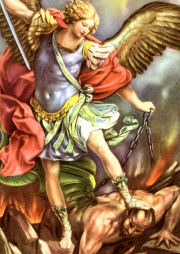

The Archangel Michael Battles Satan


The name of the archangel Michael means, in Hebrew, who is like unto God? and he is also known as "the prince of the heavenly host." He is usually pictured as a strong warrior, dressed in armor and wearing sandals. His name appears in Scripture four times, twice in the Book of Daniel, and once each in the Epistle of St. Jude and the Book of Revelation. From Revelation we learn of the battle in heaven, with St. Michael and his angels combatting Lucifer and the other fallen angels (or devils). We invoke St. Michael to help us in our fight against Satan; to rescue souls from Satan, especially at the hour of death; to be the champion of the Jews in the Old Testament and now Christians; and to bring souls to judgment.


Devotion to Michael is the oldest angelic devotion, rising in the East in the fourth century. The Church in the West began to observe a feast honoring Michael and the angels in the fifth century. 


Patron: Against temptations; against powers of evil; artists; bakers; bankers; battle; boatmen; cemeteries; coopers; endangered children; dying; Emergency Medical Technicians; fencing; grocers; hatmakers; holy death; knights; mariners; mountaineers; paramedics; paratroopers; police officers; radiologists; sailors; the sick; security forces; soldiers; against storms at sea; swordsmiths; those in need of protection; Brussels, Belgium; Caltanissett, Sicily; Cornwall, England; and more.


Symbols: Angel with wings; dressed in armour; lance and shield; scales; shown weighing souls; millstone; piercing dragon or devil; banner charged with a dove; symbolic colors orange or gold.


St. Gabriel
Annunciation by Paolo de Matteis, 1712.
The lily in the angel's hand is symbolic of Mary's virginity in Marian art.


St. Gabriel's name means "God is my strength". Biblically he appears three times as a messenger. He had been sent to Daniel to explain a vision concerning the Messiah. He appeared to Zachary when he was offering incense in the Temple, to foretell the birth of his son, St. John the Baptist. St. Gabriel is most known as the angel chosen by God to be the messenger of the Annunciation, to announce to mankind the mystery of the Incarnation.
The angel's salutation to our Lady, so simple and yet so full of meaning, Hail Mary, full of grace, has become the constant and familiar prayer of all Christian people.
Patron: Ambassadors; broadcasting; childbirth; clergy; communications; diplomats; messengers; philatelists; postal workers; public relations; radio workers; secular clergy; stamp collectors; telecommunications; Portugal; Archdiocese of Seattle, Washington.
Symbols: Archangel; sceptre and lily; MR or AM shield; lantern; mirror; olive branch; scroll with words Ave Maria Gratia Plena; Resurrection trumpet; shield; spear; lily; symbolic colors, silver or blue.


St. Raphael

Our knowledge of the Archangel Raphael comes to us from the book of Tobit. His mission as wonderful healer and fellow traveller with the youthful Tobias has caused him to be invoked for journeys and at critical moments in life. Tradition also holds that Raphael is the angel that stirred the waters at the healing sheep pool in Bethesda. His name means "God has healed".
Patron: Blind; bodily ills; counselors; druggists; eye problems; guardian angels; happy meetings; healers; health inspectors; health technicians; love; lovers; mental illness; nurses; pharmacists; physicians; shepherds; against sickness; therapists; travellers; young people; young people leaving home for the first time; and more.
Symbols: Staff; wallet and fish; staff and gourd; archangel; young man carrying a staff; young man carrying a fish; walking with Tobias; holding a bottle or flask; symbolic colors, gray or yellow.
Comment:
Each of these archangels performs a different mission in Scripture: Michael protects; Gabriel announces; Raphael guides. Earlier belief that inexplicable events were due to the actions of spiritual beings has given way to a scientific world-view and a different sense of cause and effect. Yet believers still experience God's protection, communication and guidance in ways which defy description. We cannot dismiss angels too lightly.

Quote:
"The question of how many angels could dance on the point of a pin no longer is absurd in molecular physics, with its discovery of how broad that point actually is, and what part invisible electronic 'messengers' play in the dance of life" (Lewis Mumford).

Prayer:
God, with great wisdom, You direct the ministry of Angels and men. Grant that those who always minister to You in heaven may defend us during our life on earth. Amen.

Wednesday, September 14, 2011

September 14 - Exaltation of the Holy Cross

O Crux, ave spes unica! Hail, O Cross, our only hope!

Holy Cross - San Clemente, Rome
(Detail of Apse mosaic, 12th Century)
Dying, you destroyed our death; rising you restored our life. 
Save us by your cross, Christ our Redeemer.
- from the Eucharistic Prayer


For God so loved the world that He gave His only begotten son, that whosoever believeth in Him may not perish, but have everlasting life.

- John 3:16 (Douay)


Early in the fourth century St. Helena, mother of the Roman Emperor Constantine, went to Jerusalem in search of the holy places of Christ's life. She razed the Temple of Aphrodite, which tradition held was built over the Savior's tomb, and her son built the Basilica of the Holy Sepulcher over the tomb. During the excavation, workers found three crosses. Legend has it that the one on which Jesus died was identified when its touch healed a dying woman.


The cross immediately became an object of veneration. At a Good Friday celebration in Jerusalem toward the end of the fourth century, according to an eyewitness, the wood was taken out of its silver container and placed on a table together with the inscription Pilate ordered placed above Jesus' head: Then "all the people pass through one by one; all of them bow down, touching the cross and the inscription, first with their foreheads, then with their eyes; and, after kissing the cross, they move on."


To this day the Eastern Churches, Catholic and Orthodox alike, celebrate the Exaltation of the Holy Cross on the September anniversary of the basilica's dedication. The feast entered the Western calendar in the seventh century after Emperor Heraclius recovered the cross from the Persians, who had carried it off in 614, 15 years earlier. According to the story, the emperor intended to carry the cross back into Jerusalem himself, but was unable to move forward until he took off his imperial garb and became a barefoot pilgrim.


Comment:


The cross is today the universal image of Christian belief. Countless generations of artists have turned it into a thing of beauty to be carried in procession or worn as jewelry. To the eyes of the first Christians, it had no beauty. It stood outside too many city walls, decorated only with decaying corpses, as a threat to anyone who defied Rome's authority—including Christians who refused sacrifice to Roman gods. Although believers spoke of the cross as the instrument of salvation, it seldom appeared in Christian art unless disguised as an anchor or the Chi-Rho until after Constantine's edict of toleration.


Quote:


"How splendid the cross of Christ! It brings life, not death; light, not darkness; Paradise, not its loss. It is the wood on which the Lord, like a great warrior, was wounded in hands and feet and side, but healed thereby our wounds. A tree has destroyed us, a tree now brought us life" (Theodore of Studios).


Prayers:

Adoramus te, christe, et benedicimus tibi,
quia per crucem tuam redemisti mundum.
We adore thee, O Christ, and we bless thee,
for by thy cross thou hast redeemed the world.

Almighty God, whose Son our Savior Jesus Christ was lifted high upon the cross that he might draw the whole world unto himself: Mercifully grant that we, who glory in the mystery of our redemption, may have grace to take up our cross and follow him; who liveth and reigneth with thee and the Holy Spirit, one God, in glory everlasting.


O God, who by the passion of thy blessed Son didst make an instrument of shameful death to be unto us the means of life and peace: Grant us so to glory in the cross of Christ, that we may gladly suffer shame and loss for the sake of thy Son our Savior Jesus Christ; who liveth and reigneth with thee and the Holy Spirit, one God, for ever and ever.


Suggestions for family activities:
  • If possible attend Mass together. Consider taking your family to a church that has especially fine Stations of the Cross. Look at the images and explain their meaning. At each Station pray, "We adore thee, O Christ, and we bless thee, for by thy Cross thou hast redeemed the world". At the end, have the children kneel before the Blessed Sacrament and say a Hail Mary, an Our Father, and a Glory be.
  • Make the evening meal today more festive than ordinary -- light candles on the table or use the good dishes. 
  • Read one or more of the prayers or scripture readings for the day before the evening meal. Older children could take turns doing the readings. 
  • Begin teaching even the very youngest members of the family to make the Sign of the Cross at the end of the mealtime prayers. (Older brothers and sisters usually will be very glad to help the baby with this.)
  • Explain to children the meaning of the Sign of the Cross that we make before meals, and point out how this action is intended to unite every one of us with Jesus' sacrifice for us -- His crucifixion and His resurrection from the dead. 
  • Make a point of mentioning how great is God's loves for us. Encourage children to memorize John 3:16. This is a key verse about the triumph of Jesus' sacrifice on the Cross, and encourages children to revere and respect God's word in the Bible. Give a small reward or privilege to each child who memorizes the verse. Have them recite it for you when they say their bedtime prayers.
  • Two additional suggestions:
    -- Have grade-school-age children write the verse in their fanciest writing and illustrate it with a drawing of Jesus on the Cross. Even little people think a lot when they are drawing something. Maybe you could set a crucifix on the table for them to look at when they draw it. (Don't forget to display the results on the refrigerator -- or maybe send it to grandma.)
    -- Frost a sheet cake with white icing, and make a large Cross on the cake with red icing, and pipe "John 3:16" on the Cross. Let the children help decorate the cake further by sprinkling it with silver dragees or colored sprinkles.
  • If there are crucifixes in the children's rooms, make sure to call attention to it at bedtime prayers. If not, today would be a very good time to get them.